Some fantasy stories shout with battles, prophecies and chosen heroes. Others whisper and change the reader anyway. Ruben and the Curious Cosmonaut by A R Marchant belongs firmly in the second category. It is a middle-grade fantasy that does not rely on spectacle for impact. It builds its power through silence, attention and emotional truth.
The story begins simply enough. Ruben is a quiet boy working in his grandfather’s costume shop, surrounded by forgotten props and dusty relics. But everything shifts when a battered cosmonaut helmet reacts to a mirror that should not have held anything unusual at all. In that moment, the ordinary becomes a threshold. The mirror becomes a door. And Ruben steps sideways into a place that defies explanation.
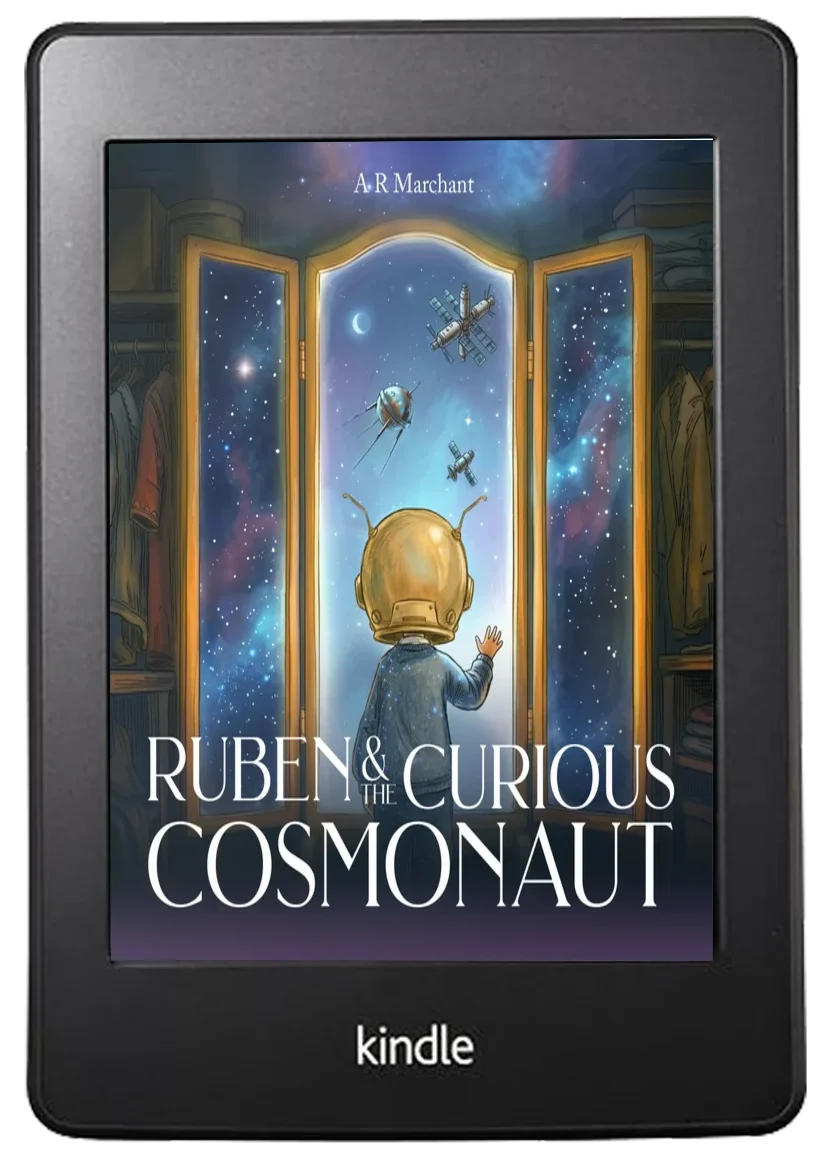
What he finds is not a polished fantasy kingdom, but the Yard: a vast, suspended expanse of floating wreckage. Broken panels drift through a silent sky. Fragments of machinery hang weightless in impossible arrangements. Entire structures appear paused mid-collapse, as if the universe itself stopped finishing the job. It is strange, disorienting and deeply atmospheric. Yet it is not empty.
The Yard is not a place of absence. It is a place of remnants that still matter.
Ruben is quickly introduced to Sparky, a small glowing companion whose presence brings warmth and guidance through the cold geometry of the Yard. Sparky is not a typical fantasy guide. He is cautious, thoughtful and shaped by long experience of a broken system. Alongside him stands the Custodian, a mechanical guardian who understands the deeper architecture of this strange world and reluctantly helps Ruben navigate its rules.
At the centre of everything is the Cosmic Engine: a vast system responsible for maintaining the connection between stars across the universe. When it weakens, stars begin to fade not just as light, but as meaning. Entire constellations lose their coherence. Distance begins to feel like disappearance. The Engine’s failure is not just mechanical. It is existential.
The book reframes heroism quietly and without announcement. Ruben is not chosen because he is extraordinary. He is not powerful in the traditional sense. He begins uncertain, hesitant and deeply aware of his own limitations. But the story does not see these traits as weaknesses. It treats them as the starting point for attention, care and responsibility.
As Ruben moves through the Yard, he must learn to interact with a world that does not respond to force. Floating mirrors must be aligned with precision. Fractured crystals must be understood rather than replaced. Unstable structures must be navigated with patience rather than speed. Every challenge reinforces a single idea: progress is not loud. It is careful.
Even silence plays a role. In the Yard, sound does not behave normally. Voices fail to travel. Movements create subtle reactions in the environment. Everything feels observed, as if the world itself is aware of how it is being treated. This forces Ruben, and the reader, to slow down and consider action before instinct.
The story’s emotional core is Ruben’s evolving understanding of belonging. At the beginning, he feels small in the face of everything he does not understand. But as he learns to repair and realign parts of the Cosmic Engine, he begins to see that belonging is not about origin or confidence. It is about participation. Showing up in a place that needs care and choosing to act gently within it.
Sparky’s journey mirrors this. His light, once flickering and uncertain, strengthens as the Engine is restored. His connection to the stars returns, reminding readers that repair is not only physical but emotional. Things and people become clearer when they are supported.
By the time Ruben returns home, the transformation is not marked by dramatic change but by perception. The world he left behind feels the same, yet he no longer experiences it the same way. Light feels richer. Silence feels fuller. Ordinary objects seem slightly more alive with meaning.
Ruben and the Curious Cosmonaut is a story about broken systems that still function, fractured stars that still shine and quiet children who discover that bravery does not always announce itself. Sometimes it simply begins with noticing what others overlook and choosing to care anyway.
Ruben and the Curious Cosmonaut is available now from Amazon
https://amzn.eu/d/07ekPNol
www.andymarchant.com