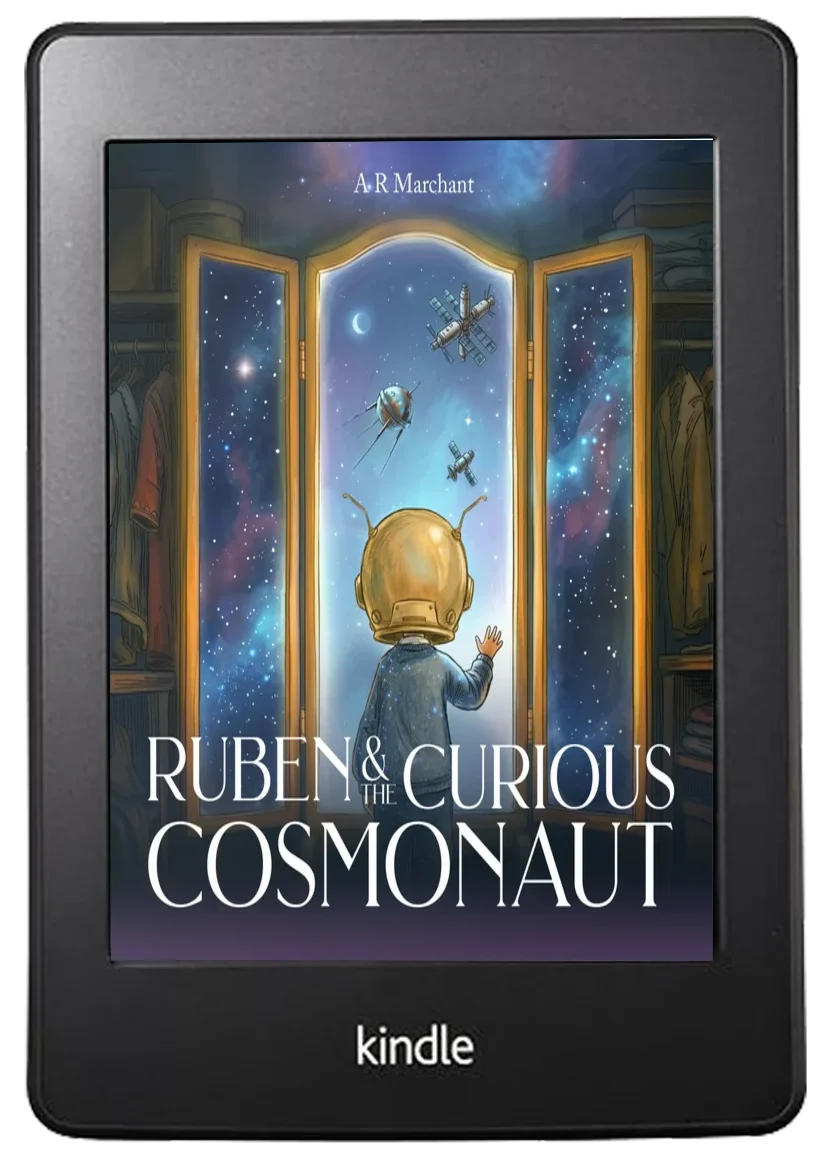
Heroism in fantasy is often loud. It arrives with swords, declarations and chosen destinies. But in Ruben and the Curious Cosmonaut by A R Marchant, heroism is something quieter: careful, uncertain and deeply human. It is the kind of courage that does not announce itself, but holds steady when everything else begins to fail.
Ruben does not begin his journey believing he is capable of saving anything, let alone an entire cosmic system. He is an ordinary boy working in his grandfather’s costume shop, surrounded by forgotten relics and faded props. But when a battered cosmonaut helmet responds to a mirror that should not have been anything more than glass, Ruben is pulled into a world far beyond his understanding.
He steps into the Yard: a suspended expanse of floating wreckage, fractured machinery and silent structures drifting in a vast, uncertain sky. It is a place where nothing is fully stable and everything seems to exist in a state between collapse and continuation. Above it all lies the fragile thread of something larger: the Cosmic Engine, a vast mechanism responsible for maintaining the connection between stars across the universe.
When the Engine weakens, stars begin to fade.
And one of those stars belongs to Sparky, a small glowing being who becomes Ruben’s companion and guide. Sparky’s home is among those slipping into dimness and his quiet urgency becomes one of the emotional anchors of the story. The stakes are enormous, but they are never distant. They are personal. They are immediate.
Ruben’s journey is not defined by power but by attention. In the Yard, survival is not about force. It is about understanding. Floating mirrors must be aligned with precision. Cracked crystals must be interpreted rather than discarded. Entire systems respond not to pressure, but to careful engagement. The universe, in this story, does not reward domination. It responds to care.
Ruben learns this slowly, often through mistakes. He hesitates. He doubts. He misjudges weight and distance in a world where nothing behaves as expected. But each error becomes an instruction rather than a failure. He discovers that even broken things still hold function and that repair is often a matter of patience rather than strength.
The centre of the Cosmic Engine holds a fragile balance that depends on quiet intent. Ruben must align seven mirrors across a drifting field of debris, each one requiring not just physical adjustment, but careful attention to how the system reacts. When he finally succeeds, it is not through force, but through listening and adapting to what the environment is already trying to communicate.
Sparky and the Custodian, the mechanical guardian of the Yard, both reflect different forms of quiet strength. Sparky’s light stabilises as the Engine awakens, becoming a living symbol of restored connection. The Custodian, precise and restrained, admits error when necessary and corrects course without hesitation. Together, they show Ruben that heroism is not a single act. It is a sustained willingness to care.
The most powerful moment in the story is not the restoration of the Engine itself, but what it represents. A dying star does not return because of grand intervention, but because small, deliberate actions align into coherence. The system heals not through force, but through accumulated attention.
Ruben does not return home transformed into someone unrecognisable. He returns more aware. He sees light differently. He hears silence differently. The ordinary world becomes layered with meaning he had not previously noticed. Not because he saved a star, but because he learned how to see the universe as something still connected, still listening, still responsive.
Ruben and the Curious Cosmonaut is a story about the kind of hero the universe rarely celebrates but always depends on: the quiet one. The one who does not overpower the darkness but carefully holds enough light in place for it to return.
Ruben and the Curious Cosmonaut is available now from Amazon
https://amzn.eu/d/07ekPNol