Silence is rarely treated as something meaningful in fantasy. It is often the space between action, the pause before something dramatic begins. But in Ruben and the Curious Cosmonaut by A R Marchant, silence is not empty. It is alive, layered and full of information. It is something to be listened to, not ignored. And it is through this silence that one quiet boy begins to understand a universe in distress.
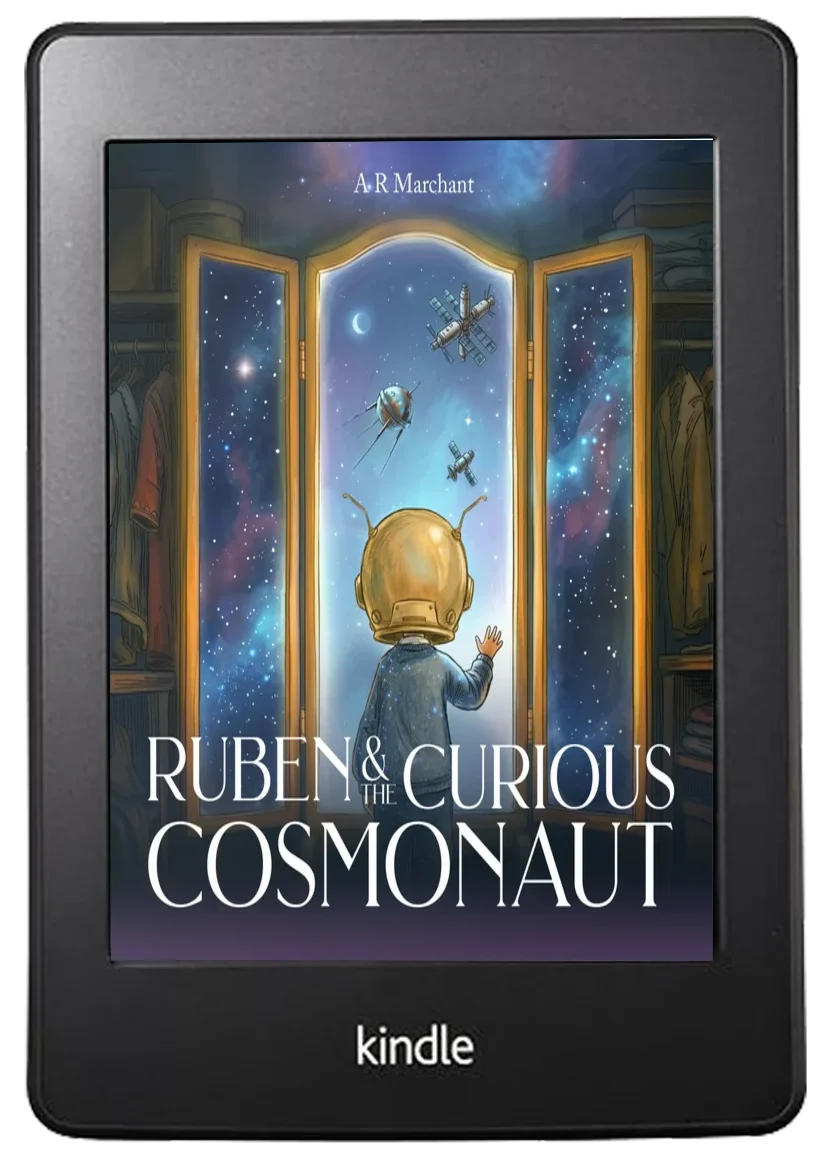
Ruben does not begin his story as a hero. He begins as an ordinary boy in a costume shop, surrounded by relics of imagined worlds. Nothing in his life suggests cosmic responsibility. Yet everything changes when a worn cosmonaut helmet reacts to a mirror that should not have been anything more than a reflection. In that moment, the familiar fractures. The mirror becomes a threshold and Ruben is drawn into a place where silence carries weight and stars are no longer guaranteed to endure.
He arrives in the Yard: a vast, suspended landscape of floating wreckage, broken structures and drifting machinery held together by a fragile logic. Above it lies the system that keeps everything connected: the Cosmic Engine. When the Engine weakens, stars begin to fail. Not explosively, but quietly. They fade. They lose coherence. They drift out of connection.
And in this universe, fading stars are not just distant events. They are signals of imbalance across everything.
The first thing Ruben must learn is not how to act, but how to listen. The Yard does not behave like a conventional world. Sound does not travel normally. Movement creates subtle shifts in structure. Even presence itself feels registered by the environment. Silence here is not absence. It is communication.
At first, Ruben does not understand this. He expects answers to be spoken. He expects instructions to be clear. He finds instead a world that responds indirectly, through movement, resistance and stillness. A panel that creaks underfoot is not just unstable. It is speaking. A drifting fragment of machinery is not just debris. It is part of a larger memory that has not yet resolved.
Sparky, the small glowing companion who guides Ruben, understands this language instinctively. His light shifts in response to stability and imbalance, acting as a living signal of the Yard’s condition. The Custodian, the mechanical guardian of the Engine, speaks sparingly but precisely, revealing that the system’s failures are not sudden but cumulative, built from moments of misalignment that were never corrected.
As Ruben learns to navigate this world, he discovers that listening is not passive. It is an active form of attention. When he aligns mirrors across the drifting field, he does not do so through force. He does it by noticing how the system already wants to move. When he adjusts fractured components of the Engine, he learns that resistance is not rejection. It is information.
The realisation arrives gradually: the silence of the Yard is not empty. It is structured. It is shaped by everything that has happened before. And if stars are beginning to fail, then the silence is where that failure can first be heard.
Ruben’s transformation is not marked by sudden confidence, but by deepening awareness. He becomes someone who notices before he acts. Someone who understands that hesitation can be a form of listening. The universe does not always speak loudly, but it always speaks.
When the Cosmic Engine is finally restored, it is not through noise or spectacle. It is through alignment. Through careful attention to patterns that were always present but needed to be recognised. The stars do not return because they are forced back into place. They return because the connection is restored.
By the time Ruben returns home, silence is no longer something he avoids. It is something he understands. The ordinary world feels subtly different, not because it has changed, but because he has learned how to hear it. The pauses between sounds, the stillness between actions, the quiet in everyday life: all of it carries meaning now.
Ruben and the Curious Cosmonaut leaves the reader with a quietly powerful idea: when stars begin to fail, the first step toward saving them is not action, but listening. And sometimes, the boy who saves the universe is the one who finally understands what the silence has been trying to say all along.